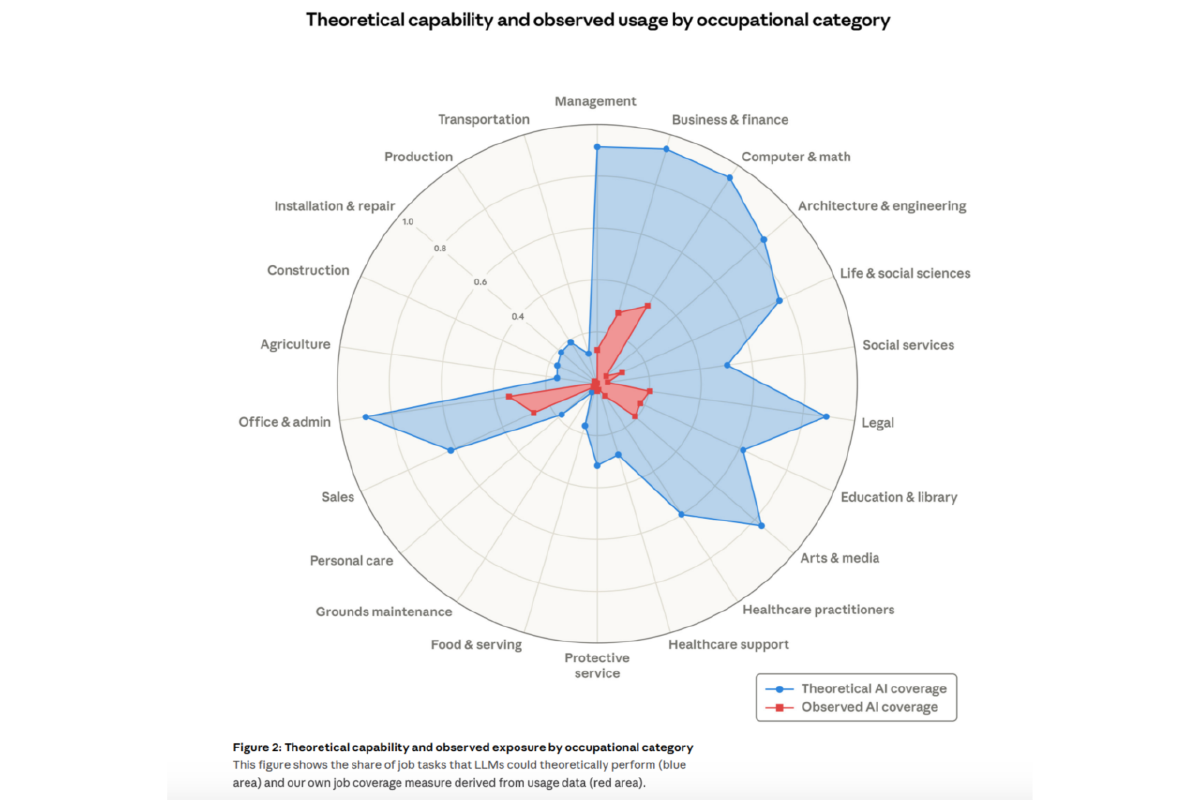

Look at this chart carefully. It’s not an analysis of what AI has destroyed. It’s an X-ray of what it’s about to destroy.
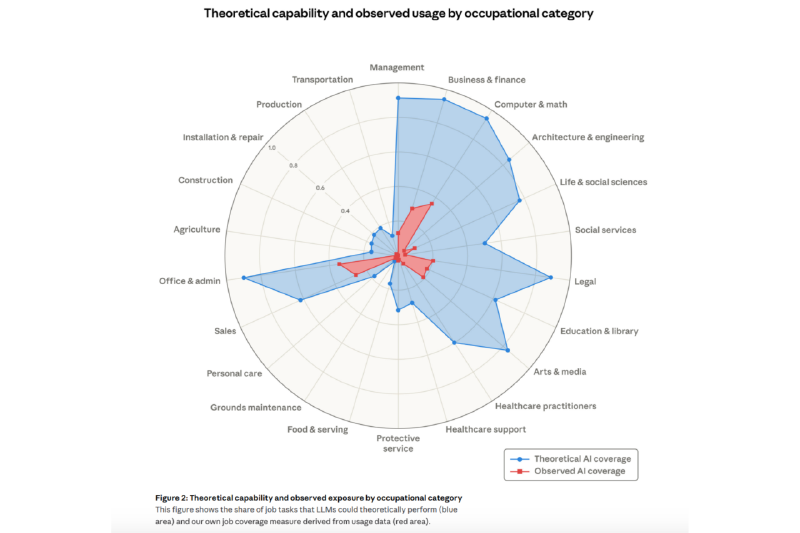
The blue area is what AI can do today. The red area is what AI is doing today. The difference between them isn’t a safety margin. It’s a tsunami that hasn’t hit shore yet.
The Study: 2 Million Conversations with Claude#
Anthropic just published Labor market impacts of AI: A new measure and early evidence, and it’s the most rigorous analysis I’ve seen on AI’s real employment impact.
What did they do? They crossed three data sources:
- The O*NET database, cataloging tasks across ~800 US occupations.
- Real Claude usage data — 2 million conversations analyzed via the Anthropic Economic Index.
- Theoretical estimates from Eloundou et al. (2023) on which tasks an LLM can make at least twice as fast.
The result is a new metric: observed exposure — not what AI could theoretically do, but what it’s actually doing in professional settings. And the most revealing finding isn’t the absolute numbers — it’s the gap between the two.
The 10 Most Exposed Jobs#
The ranking won’t surprise anyone who’s been paying attention, but the numbers are brutal:
- Computer Programmers — 75% coverage. Three out of four tasks a programmer does, Claude already handles.
- Customer Service Representatives. First-party API traffic shows massive automation.
- Data Entry Keyers — 67%. Reading documents and entering data. The perfect automation use case.
The list continues: actuaries, financial analysts, technical writers. Office jobs. White-collar work. People with college degrees.
On the other end, 30% of workers have zero exposure. Cooks, motorcycle mechanics, lifeguards, bartenders. Jobs where hands, bodies, and physical context are irreplaceable.
Ironic, isn’t it? Decades telling us automation was coming for manual labor. It’s coming for the desks.
The Demographic Surprise#
This is where the study shatters the dominant narrative.
The workers most exposed to AI are:
- 16 percentage points more likely to be female
- 11 points more likely to be white
- Nearly twice as likely to be Asian
- Earn 47% more than unexposed workers
- 17.4% hold graduate degrees (vs. 4.5% in the unexposed group)
This isn’t the displaced factory worker narrative. These are lawyers, analysts, programmers, university professors. The professional class that thought it was untouchable.
When I say this will reshape social structure, I’m not exaggerating.
The Gap IS the Prediction#
Go back to the chart. Look at the categories:
- Computer & Math: 94% theoretical capability, 33% actual use
- Legal: ~85% theoretical, less than 15% observed
- Education: ~70% theoretical, less than 15% observed
- Office & Admin: 90% theoretical, a fraction of actual use
That distance between blue and red isn’t comfort. It’s latency.
It’s the time companies take to adopt, regulators to adapt, workflows to reconfigure. But the technology is already there. The model already knows how. The ecosystem just needs to catch up.
And every month, the red area grows. Anthropic says it explicitly: “As capabilities advance, adoption spreads, and deployment deepens, the red area will grow to cover the blue.”
This isn’t speculative prediction. It’s an empirical observation with trajectory.
What Changes with AI Agents#
Here’s the factor the study doesn’t fully measure — because it didn’t exist at this scale when they collected the data.
The study analyzes LLM usage — conversations with Claude. Chat interactions. A human asks, the AI answers. It’s the augmentation model: AI helps you, you execute.
But AI agents are something else entirely. They don’t answer — they act. They execute task chains autonomously. They navigate systems, make intermediate decisions, complete entire workflows without human intervention.
What we’re building at Tecnológico de Monterrey with AgenTECs is exactly this. Not a chatbot that helps you draft an email. An agent that manages the entire process: reads context, drafts, sends, follows up, escalates if there’s no response.
When agents arrive at enterprise scale — and they’re already arriving — the red area in the chart will expand explosively. Because you no longer need a human interacting with AI task by task. The agent covers the entire role.
Think about the Legal category: 85% theoretical capability, <15% current use. What happens when an agent can review contracts, identify risk clauses, generate executive summaries, and prepare response drafts — all without a lawyer touching the keyboard? The 85% becomes the new floor, not the ceiling.
What to Do (Which Is Not Panic)#
I’ve been saying the same thing for years: this isn’t about fear. It’s about preparation.
When I wrote “El fin del desarrollador” on LinkedIn, the reaction was predictable: “exaggerated,” “developers will always be needed,” “AI can’t do X.” The same arguments I heard about TECgpt when we launched it and people said professors would never use it. Today we have over 60,000 active users.
The metaphor I use is the orchestra conductor. The value is no longer in playing the violin — it’s in knowing what music to perform, who plays what, and when to change the score. Future professionals don’t execute tasks — they orchestrate systems that execute them.
Specifically:
- Massive upskilling, now. Not “intro to AI” courses — real training on production tools.
- Redefine roles, don’t eliminate them. A lawyer who masters AI agents is worth more, not less. But a lawyer who only knows manual contract review has an expiration date.
- Measure exposure in your organization. Use Anthropic’s framework. Identify which tasks in each role an LLM can already perform. Design the transition before it’s imposed on you.
- Create new roles that don’t exist yet: AI orchestrators, agent prompt engineers, autonomous systems supervisors.
The Bottom Line#
The BLS projects that the most exposed occupations under this metric will grow less through 2034. For every 10 points of observed coverage, the growth projection drops 0.6 percentage points. This isn’t casual correlation — labor market analysts are seeing the same thing.
And yet, Anthropic also finds that there’s no systematic increase in unemployment in the most exposed professions. Yet.
That’s the window. We’re in the moment between seeing the lightning and hearing the thunder. The bolt already struck. The question isn’t whether the sound will arrive, but whether you’ll be ready when it does.
Those who read this chart as “AI hasn’t affected employment much yet” are confusing latency with safety. Those who read it as “a structural labor market shift is coming and we need to act now”… they’re the ones who’ll still be conducting the orchestra.