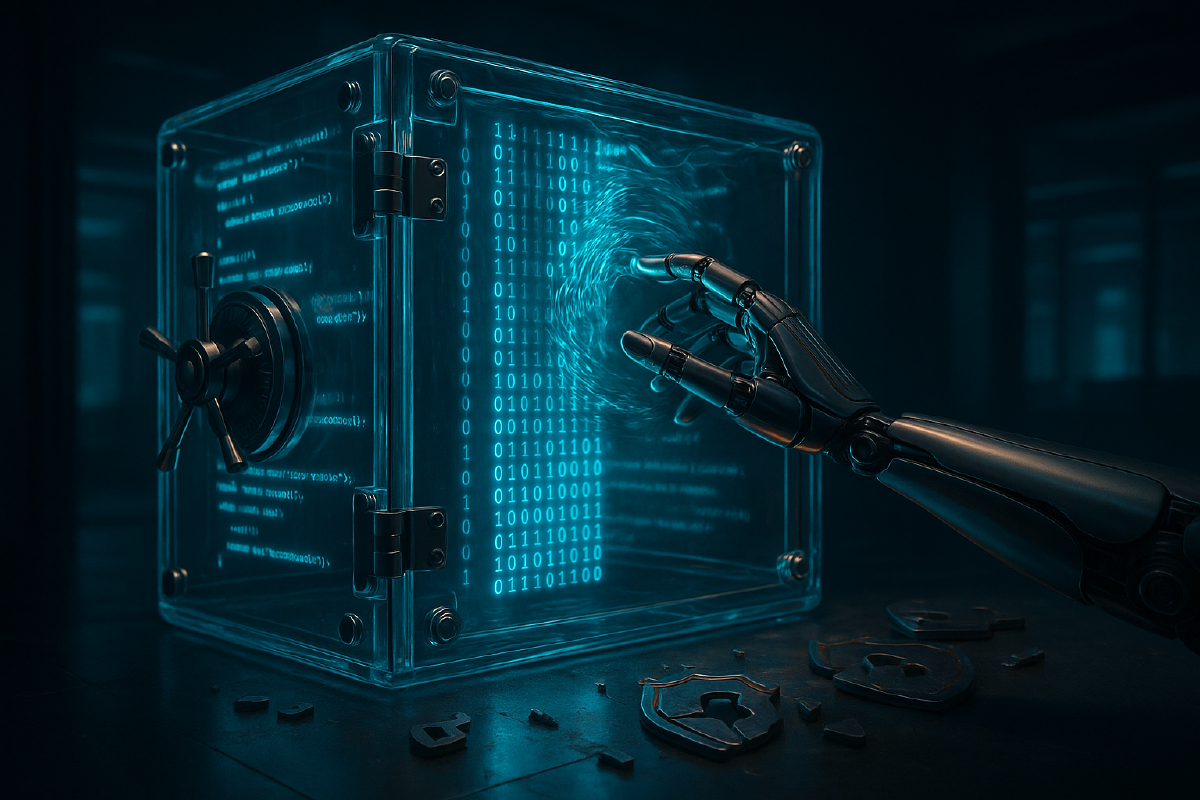

On April 1, 2026 — and no, it wasn’t a joke — someone discovered that Claude Code’s npm package, Anthropic’s command-line tool, included a misconfigured .map file. That file contained the complete source code: 512,000 lines of TypeScript spread across 1,900 files.
Within hours, the leaked repository had 25,000 stars on GitHub. Developers were tearing it apart piece by piece. But the truly unsettling part wasn’t the leak itself.
It was what happened next.
From TypeScript to Python in an afternoon#
A researcher at the University of Washington took the leaked code, fed it through OpenAI Codex, and within hours had a functional reimplementation in Python. Not a copy — a complete rewrite in a different language. The resulting repository, claw-code, hit 44,500 stars. A Rust rewrite is already underway.
And here’s the legal problem that should keep every CTO up at night: a reimplementation in another language, generated by an AI agent, is likely immune to a DMCA takedown. It’s not a copy. It’s a derived work created by a machine. Current legal frameworks simply aren’t designed for this.
Gergely Orosz, one of the most respected voices in software engineering, put it this way: we’re facing a new reality where any closed codebase is one agent session away from being functionally cloned.
Read that again. Any codebase. One agent session. Cloned.
What they found inside#
The findings were fascinating and, in some cases, hilarious. Wes Bos discovered 187 hardcoded verbs for the loading spinner (including “hullaballooing” and “razzmatazzing”). They found an internal analytics system that flags your prompt as negative every time you swear at the agent. And the random 4-character IDs are filtered to exclude 25 curse words.
But beyond the anecdotes, the technical discoveries revealed the real architecture of one of the world’s most advanced coding agents:
- 35 modules with clearly separated responsibilities.
- A lightweight memory system based on ~150-character pointers, not bulk storage.
- System prompts live on the client, not the server.
- Code comments are written for LLMs to read, not humans.
That last point deserves a pause. Anthropic is no longer writing code for programmers to understand. They’re writing code for other AI models to understand. If that doesn’t tell you where the industry is heading, nothing will.
The protective barrier that no longer exists#
For decades, proprietary code was one of the most reliable protective barriers in technology. Your competitor could copy your idea, your design, your go-to-market strategy — but replicating a million lines of optimized code took years and hundreds of engineers.
That’s over.
I’m not exaggerating. Think about what actually happened this week:
- A configuration error exposed complete source code.
- An AI agent rewrote it in another language in hours.
- The open source community improved and extended it in days.
- The result is legally difficult to challenge.
Each of these steps was unthinkable two years ago. Together, they represent a fundamental shift in what it means to “protect” your software intellectual property.
And you don’t need a leak for this to happen. AI agents can already:
- Infer architectures from the observable behavior of an API.
- Replicate functionality from public documentation and examples.
- Generate alternative implementations that achieve the same results with different code.
Code was never really a barrier. It was the illusion of a barrier.
The SaaSpocalypse connection#
If this story sounds familiar, it’s because we already saw act one. In February of this year, I wrote about the SaaSpocalypse: $300 billion evaporated in 48 hours when the market understood that the business logic of a $200/user/month SaaS fits in a text file that an agent can read and execute.
The Claude Code leak makes that thesis worse in a way that few have articulated yet.
Think about it: every SaaS provider exposes documented public APIs. Endpoints, data schemas, workflows, business rules — all accessible to any agent that can read documentation. The Claude Code leak proved that an agent can take 512,000 lines of code and reimplement them in hours. Now combine that with the fact that most SaaS products expose their business logic through their own APIs.
You don’t need to steal Salesforce’s source code. You just need an agent that reads their public documentation, observes endpoint behavior, and infers the underlying architecture. The API is the blueprint.
Satya Nadella said it in December 2024: “SaaS applications are CRUD databases with business logic on top. Agents will absorb that logic.” In February, the market understood this in the abstract. With Claude Code, we have concrete proof: the tools to absorb that logic already exist. And they work.
The SaaSpocalypse wasn’t the ending. It was the trailer.
So what actually protects your business?#
If code is no longer your competitive advantage — and public APIs reveal your business logic — what’s left? After 20 years in technology transformation, from banking in Spain to education in Mexico, I’ve seen this same question emerge every time a new technological wave destroys the previous barriers:
1. Data, not code. Your model trained on proprietary data, your curated datasets, your domain knowledge encoded in features that an agent can’t infer from the outside. A Claude Code clone can replicate the tool, but it can’t replicate the millions of conversations that trained Claude.
2. Speed of execution. If your competitor can clone your code in hours, the advantage lies in being the first to solve the next problem. Not in protecting the previous solution.
3. Trust and brand. In a world where anyone can replicate the technology, differentiation comes down to who trusts you. Anthropic’s customers aren’t going to migrate to claw-code to save on their subscription. They pay for support, for SLAs, for the guarantee that someone responds when something breaks.
4. The ecosystem. Integrations, partnerships, network effects. Slack didn’t win because its code was uncopyable. It won because everyone was already there.
5. A culture of continuous innovation. If you assume that everything you build today will be replicable tomorrow, your only sustainable advantage is the ability to build the next thing faster than anyone else.
The implications for the enterprise#
For any technology leader reading this, the message is clear: review your intellectual property strategy today. Not tomorrow. Today.
Some questions that should be on the agenda for your next board meeting:
- How much of our competitive advantage depends on code that an agent could replicate?
- What does our own API documentation reveal about our business logic?
- Do we have proprietary data that is genuinely hard to reproduce?
- Does our security strategy account for the fact that a misconfigured
.mapfile can expose our entire codebase? - Are we prepared for a world where DMCA doesn’t protect against AI-generated reimplementations?
And perhaps the most uncomfortable one of all: Are we still investing in building walls, when we should be investing in running faster?
The twist no one expected#
There’s a delicious irony in this whole story. Claude Code — Anthropic’s tool designed for AI to write code — was dismantled and rewritten by the AI of its direct competitor. OpenAI Codex cloned Anthropic’s flagship product in an afternoon.
It’s as if Ford had invented the assembly line and Toyota had copied it the same day using Ford’s own robots.
Welcome to the era where the tools you build to automate other people’s work can be used to automate your own work. Where your code is not your protective barrier. Where your advantage is not what you already built, but what you’re going to build tomorrow.
The Claude Code leak wasn’t a security incident.
It was a warning.
Carles Abarca is VP of Digital Transformation at Tecnológico de Monterrey and former CTO of Banco Sabadell. He writes about AI, digital transformation, and the future of software at carlesabarca.com.