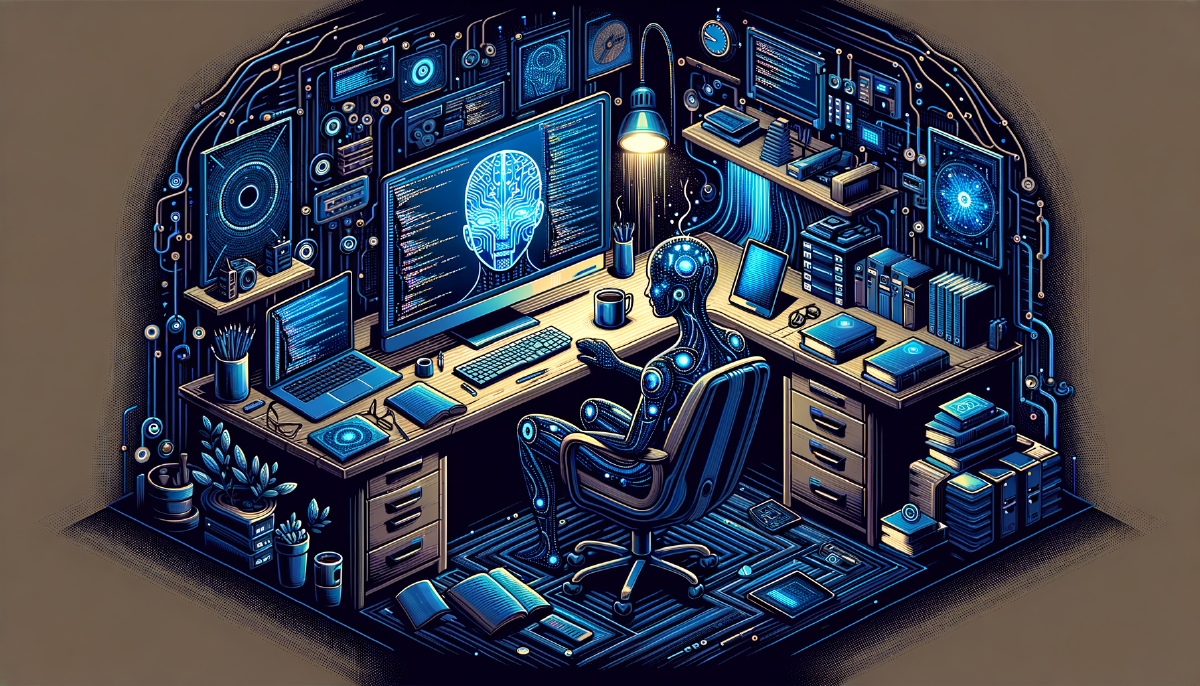

The End of the Junior Developer: The Future of Software Development with AI Agents
In a world where artificial intelligence advances at breakneck speed, an uncomfortable truth looms on the horizon of the technology industry: the junior developer role may be on the path to extinction. This is not science fiction but an emerging reality that is already transforming how we build software.
The Silent Revolution of AI Agents#
Today, AI is no longer just an assistant that completes code. AI agents are evolving into autonomous entities capable of perceiving the development environment, making complex decisions, and executing complete programming tasks with minimal human oversight. We are no longer talking about simple tools, but digital collaborators that are reconfiguring the entire development chain.
From Assistant to Autonomous Agent#
AI-based code assistants like GitHub Copilot or Codeium have already transformed developer productivity. However, what is coming is far more disruptive: specialized agents working in concert to manage the entire development lifecycle.
What does this mean? While today a junior developer can still ask an AI to generate boilerplate code or explain complex systems, tomorrow a technical architect will be able to instruct a complete team of agents to:
- Develop complex code based on high-level requirements
- Perform exhaustive testing and bug resolution
- Optimize performance without manual intervention
- Manage deployments and update documentation
The Prediction That Is Already Happening#
Mark Zuckerberg stated it without ambiguity: “By 2025, AI will be capable of functioning as a mid-level engineer, writing code and potentially replacing software developers.” We are not talking about a distant future, but a reality that is already emerging.
According to Gartner, by 2027 generative AI will require 80% of the engineering workforce to upskill, creating new roles and eliminating others. The question is no longer whether it will happen, but when it will reach the tipping point that transforms the entire ecosystem.
Orchestration: The New Paradigm#
The key concept here is AI agent orchestration: a process by which multiple specialized agents work together within a unified system. Each agent focuses on a specific task — UI design, backend development, testing, security — while a central entity (human or AI) conducts the symphony.
The Architect as Orchestra Conductor#
In this new paradigm, the technical architect becomes the true protagonist. Their role evolves from solution designer to strategic director of an AI agent team, defining:
- The system vision and requirements
- Technical and business constraints
- Architecture and quality standards
- Resolution of complex problems that require human judgment
This transformation is already happening. According to ServiceNow/Pearson research, by 2027 18.7% of technical architect tasks will be at least partially augmented by AI. Architects will focus less on guiding code implementation and more on directing and supervising the autonomous work of agents.
The Experience Crisis#
Here the fundamental dilemma arises: if AI agents can handle the tasks traditionally assigned to junior developers, how will new professionals acquire experience?
One of the greatest concerns is precisely how junior developers can grow into mid-level and senior roles if AI handles most of the routine coding. Traditionally, developers have learned by doing — writing, debugging, and refactoring real-world code. Without that hands-on experience, there is a risk that developers will not fully understand the complexities of software development.
A Future Without Traditional Juniors#
My thesis is that the developer role, as we know it, will disappear. In its place, we will see:
- Prompt and orchestration engineers: Professionals specialized in directing and extracting maximum value from AI agents.
- Verification and review specialists: Experts in evaluating AI-generated code, identifying edge cases, and testing its reliability.
- High-level system designers: Professionals focused on architecture and system design, where higher-level thinking remains primarily human.
Companies are already hiring fewer junior engineers due to AI-driven productivity improvements. This trend will only accelerate as AI agents mature.
Adapt or Fall Behind#
For current professionals, the message is clear: the developer career is evolving, not disappearing. The future belongs not to those who resist AI nor to those who depend on it exclusively, but to those who learn to work symbiotically with these tools.
The most successful developers will be those who:
- Master prompt engineering to guide AI agents
- Develop sharp evaluation and verification skills
- Focus on areas where human creativity and systems thinking are irreplaceable
- Deeply understand orchestration and collaboration between multiple AI agents
Are We Ready for This Change?#
If my thesis is correct, we face a radical transformation in how we educate future developers and structure technical teams. Universities, bootcamps, and companies will need to completely rethink their training and hiring programs.
The question is not whether AI agents will revolutionize software development — they already are — but how quickly we will adapt as an industry to a world where humans design and direct, while AI agents build and implement.