
Sometimes an acquisition says more about the future of an industry than a thousand strategy decks.
On June 16, 2026, SpaceX agreed to acquire Cursor, the AI-powered development platform created by Anysphere, in a stock deal valued at $60 billion. The move came only days after SpaceX’s public listing and after an earlier agreement that had already given it the option to buy Cursor or deepen a development partnership.
The superficial reading is obvious: a rocket company is buying a tool for programmers.
But that reading is too small.
The interesting question is not why SpaceX wants a code editor. The right question is why a company that already controls rockets, satellites, connectivity, data, compute and now xAI wants to control a critical part of the software creation workflow.
The answer is one word: infrastructure.
Not infrastructure understood only as steel, fiber, chips or data centers. Infrastructure in a deeper sense: the ability to turn knowledge into execution.
Cursor is not the product. It is the work layer#
Cursor is not simply a code editor with autocomplete. Its value is that it has captured an increasingly important part of engineers’ daily workflow: understanding existing code, generating new components, navigating complex codebases, proposing changes, detecting errors and accelerating iteration.
That may sound like a productivity improvement. And it is. But for an organization like SpaceX, where software governs satellites, orbital operations, telemetry, navigation, communications, simulations, vehicles, manufacturing and autonomous systems, a marginal improvement in the engineering cycle is not marginal.
When a company reduces the friction between detecting a problem, understanding it, modifying the system, testing it and deploying it, it changes its operating speed. In physical industries, that speed matters. In space, it matters even more.
That is the point: SpaceX would not be buying only a programming tool. It would be buying an interface between human knowledge, AI models and complex technical systems.
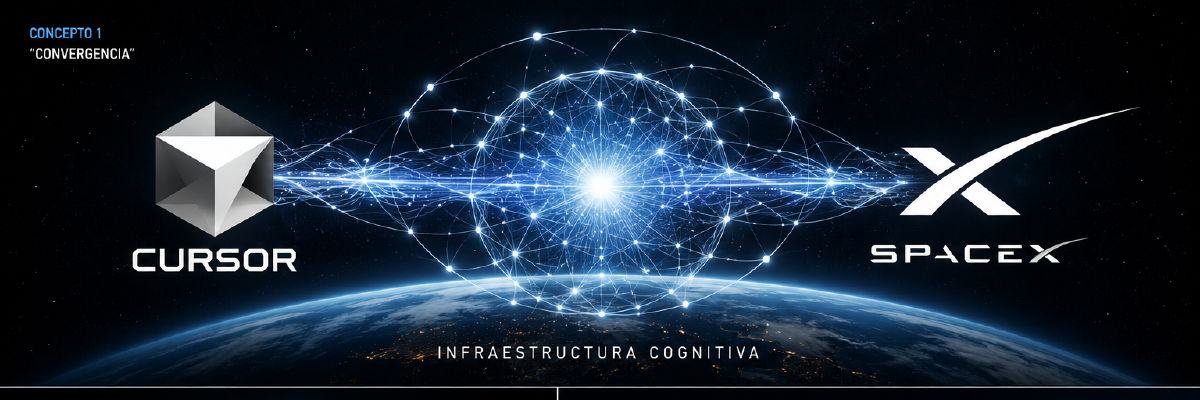
That is cognitive infrastructure.
Cognitive infrastructure#
For decades, industrial competitive advantage was built on physical infrastructure: factories, networks, logistics, energy, telecommunications, satellites and data centers.
Then came digital infrastructure: cloud, APIs, data platforms, enterprise software and automation.
Now we are entering another phase: cognitive infrastructure. Systems that do not only store information or execute processes, but help reason, decide, program, coordinate and act on increasingly complex systems.
The Cursor acquisition fits that transition for three reasons.
First, software is already a central layer of any advanced infrastructure. A modern rocket is not only propulsion. A satellite is not only hardware in orbit. A network like Starlink is not only a physical constellation. All of it exists as a combination of hardware, software, data, control, automation and continuous operations.
Second, scarcity is not only about chips or talent. It is also about the ability to coordinate expert knowledge at scale. In deep engineering organizations, much of the bottleneck sits in understanding legacy systems, transferring context, reducing errors, automating tests and accelerating technical decisions. AI development tools attack precisely that bottleneck.
Third, SpaceX is not making this move in isolation. Its integration with xAI, its investments in compute and the narrative around enterprise AI applications suggest a broader ambition: not only to use AI internally, but to turn it into a structural part of its value proposition.
In that context, Cursor can become more than a tool for programming faster. It can become one component in a larger architecture: models, compute, data, engineering and deployment integrated into a single cycle.
From rockets to operational platforms#
The SpaceX story is usually told as a story of reusable rockets. But it increasingly looks like a story of vertical integration.
First, physical access to space through launch vehicles.
Then, global connectivity through Starlink.
Then, defense and data services through Starshield.
Now, artificial intelligence, compute and tools to accelerate software production.
Seen this way, Cursor is not an oddity. It is another piece in a chain of control: access, connectivity, data, intelligence and execution.
When a company controls those layers, it stops being only a space transportation company. It becomes a provider of integrated operating capacity. It cannot only place assets in orbit; it can offer the infrastructure to operate, coordinate and automate complex systems.
This is the part many organizations should watch closely. The battle is not only about having better AI models. Nor is it only about having better applications. The battle is over who controls the layers where real work happens.
The lesson for AI startups#
The Cursor story leaves a clear lesson for any AI startup: having interesting technology is not enough. You need to understand which layer of the architecture your value lives in.
Many AI companies are born as features. Some manage to become products. Very few become infrastructure.
The distinction matters.
A feature improves a specific task. A product solves a recurring problem. An infrastructure layer changes how others work, build and operate. It becomes part of the daily workflow. It creates dependency. It accumulates context. It captures distribution. Above all, it becomes hard to replace because it does not only provide a capability; it organizes work around it.
That is what Cursor has achieved in part of the software development world. It is not only that it helps people write code. It is that it is starting to occupy the point where intent, knowledge, context and execution meet.
That is why it makes sense for a company obsessed with speed, vertical integration and complex systems to want that layer inside its strategic perimeter.
The right question#
The real news is not that SpaceX wants to buy a programming tool.
The news is that the infrastructure of the future will not be only physical or digital. It will also be cognitive.
The winners will not only be those who build the best rockets, the best models or the best applications. They will be those who can connect physical infrastructure, data, compute, artificial intelligence and workflows into systems that learn, iterate and execute faster than their competitors.
In that game, Cursor is not an editor.
It is a signal.
Carles Abarca is VP of Digital Transformation at Tecnologico de Monterrey and former CTO of Banco Sabadell. He writes about the strategic implications of AI, digital infrastructure and technological transformation at carlesabarca.com.